
CALENDAR
 
2012
ACTIVITIES
 
MEMBERS' CARS
 
PAST
ACTIVITIES
 
ADVERTISING
 
NEWSLETTERS
 
PLYMOUTH HISTORY

Nat'l POC logo

Tech Committee

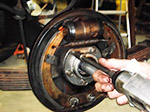
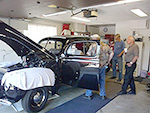
Tech CommitteeClub members get together regularly to work on each others' cars. The Committee meets on the first Saturday of each month, wherever they might be needed. Chuck Willis heads up the CPPC Technical Committee. You can email him from here by clicking on his name, or phone him at 503-668-0129.

The usual deal is that there is no charge for the labor, and the member provides parts. Also doughnuts and coffee. However, over the years parts have been donated the club, and if the Committee has donated parts on hand, they are either free or exceedingly reasonable. The committee knows what's available.

Current Tech Committee members are: Dave Williams, Charles Willis, Dennis Markovich, Marlo Edman, Pat Brost, Bob Dimick, Loren Bennett, David Pollock, Tim McCarthy, Philip Post, and Dennis Rice.

On this page …

We're accumulating articles, pictures and other information likely to interest folks who work on and restore their own Plymouths.

Click on the blue titles to see the article.

So far we've got:

___________________________________________________________________

"You're Grounded!"

By Pat Brost

These two words can strike fear into the hearts and minds of most teenagers, but when referring to our Plymouths, that's a good thing.

Some of the early 6-volt positive-to-ground cars connected the positive cable to the block or frame. If your car has never been restored or is an older restoration, you may need to check these connections.

Clean the metal surrounding the terminal and replace a bad cable or cables, and use a stainless steel nut, bolt, or lock washer.

The early cars that grounded their head- and tailllights through a grille shell or fender are especially prone to a poor connection.

Where possible, run a no. 16 wire (black or grey so it doesn't show) up into the headlights and solder or bolt to the socket base. Do the same for the taillights. Connect these wires and hide them in the car's frame, and then connect them together near the positive ground cable. Then run a larger woven ground strap from that wire connection to said cable. This might not be practical in all applications, but you will now have a good ground connection.

After doing this and you are working on your car and accidentally cause a short, your fuse will blow immediately instead of bubbling for 5 or 10 seconds while your wiring is burning. If you early car has no fuse, install one near your amp gauge.

If your car has been restored, sometimes too much paint can get in the way of a good ground connection. You may wish to add a medium-sized ground strap with an eye at both ends to the engine or transmission and then to a clean connection on the frame.

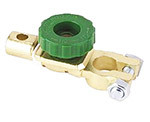
Another very important item is a large or marine-type shutoff switch in the battery circuit. This can sometimes be hidden, and will protect your battery from possible drainage.

Stay grounded, my friends!


__________________________________________________________________

Bob's no-nonsense instructions for bleeding brakes

By Bob Westphal
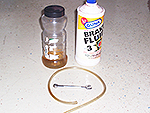
Bleed Brakes 300Over the last few months I have become more aware that a large number of people in the car hobby and in our club make a big deal out of bleeding the brakes on their cars. Also most people will allow expensive fluid to run onto the suspension and backing plate, which not only makes a mess but it can damage that precious paint they recently applied. Eventually the fluid drips onto the floor/ground which is environmentally a no! no!

My son-in-law, who has been around cars for a long time, recently asked me to help him bleed his brakes. He was trying to use a hand operated vacuum pump for which he just paid $36. Before we were done with the first wheel he had hand cramps. Needless to say I taught him this easy process.

You don’t need to purchase expensive equipment such as a pressure bleeder or vacuum pump. Brake bleeding is really a very easy process that can be done all by yourself with minimal amount of very low cost tools. I have used this easy process for at least half a century most of time alone. Here is a list of tools you will need:

A piece of clear plastic tubing 18 - 24 inches long that fits snugly onto the bleeder nipple (about 3/16 ID). Cost maybe $2
A clear bottle that will hold at least a pint of fluid. Mayonnaise jars work well - cost - zip.

Here’s how it’s done. The process is easier with two people but like I said can easily be done by one person.

Pour about 1 1/2 to 2 inches of fluid in the bottle. Connect the tubing to the bleeder. Place the bottle of fluid on the floor/ground being careful so that it won’t tip over and stick the other end of the tubing into the bottle so that it goes to the bottom of the bottle. Crack open the bleeder. Get in the car and start pumping the brake peddle. The idea is to pump the pedal until there are no bubbles in the tubing. You will have to get out and check to see if the bubbles are gone a few times. When the bubbles are gone tighten the bleeder. Pour some of the fluid back into the master cylinder and move onto the next wheel. Since all the fluid you drain from the system is caught in the bottle, there will be minimal mess if any to clean up and you haven’t damaged the environment. I have never found any need to start bleeding on the wheel farthest from the master cylinder as you will remove all the air no matter what.

There is no need to pump the pedal until it is hard to push. If all the air is gone, the pedal will be hard. The reason this works is that no air can back into the system because the end of the tube is in fluid thus not allowing air back into the system. Only fluid will be drawn back into the lines.

___________________________________________________________________

Phil Hall's 1954 Plymouth with Hy-Drive

Editor’s note: In the American race to fully-clutchless driving, Chrysler Corporation came in dead last, a full 14 years after GM rolled out the first Oldsmobiles with Hydra-Matics in 1940. Although the company had Fluid Drive, which wasn’t clutchless at all, and the clunky four-speed M6 semi-automatic, which could be driven clutchless until you needed reverse, neither option trickled down to Plymouth. Even overdrive wasn’t available until mid-1952. Then in mid-1953, Plymouth introduced Hy-Drive, another non-automatic which seemed to answer a question that no one was asking. There’s little information available about Hy-Drive, so when I learned that Phil Hall had a unit in his ‘54, I asked him tell us about it. –RPW


by Phil Hall
I am pleased to have been asked to write an article on Plymouth’s Hy-Drive.  We have owned our 1954 Hy-Drive equipped Plymouth for almost thirty-eight years.  It was a principle mode of family transportation for thirty-three years of those years.  It has always been tagged and running, and has accumulated over 300,000 tough-service miles.   

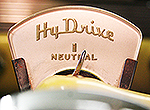
HyDrive LogoHy-Drive was offered in Plymouths from approximately mid-model year 1953 through most of model year 1954.  In mid-model year 1954 Hy-Drive was joined as a Plymouth option by the fully automatic Powerflite transmission.  Before the end of the model year, Hy-Drive was no longer offered.  The Hy-Drive option added $146 to the cost of a 1954 Plymouth.  Plymouth advertised the Hy-Drive as the smoothest and least expensive no-shift driving in the low-priced field.   In a parallel to the Hy-Drive moniker, the 1954 exterior and interior color and trim combinations were advertised under the name Hy-Style.  

HyDrive selectorWhat is a Hy-Drive?  Hy-Drive consists of a torque converter followed by a flywheel, clutch-pressure plate and standard transmission.  The pressure plate and clutch are of a special construction; the pressure plate is heavy duty and the 8 ½ inch clutch contains no dampening springs.  The 100 horsepower 1954 Plymouth engine developed 177 foot-pounds of torque at 1200 RPM.  The torque converter multiplied this torque 2.6 to 1, thereby producing an impressive 460 foot-pounds.  (Buick’s Dynaflow transmission used a torque converter that multiplied torque 2.25 to 1.  There was no multiplication of torque in the Chrysler, Dodge, Desoto fluid coupling.)  Plymouth engineers used a specially built standard transmission with heavy duty gears on Hy-Drive equipped cars to withstand the extra torque.   The standard engine does not interchange in a Hy-Drive equipped Plymouth; the Hy-Drive engines are manufactured with oil passages with “O” ring seal groves, and bolt holes for the adapter plate between the engine and converter housing.  Other interesting mechanical notes of Hy-Drive equipped Plymouths are the use of a special engine oil pump with an internal by-pass valve; the use of a special carburetor with a dash pot; and the use of a neutral safety switch requiring the car to be in neutral for starting.  

How does one operate Hy-Drive?  To put it into gear or to shift through the gears, one uses the clutch.  In normal operation, one drops it into third gear and thanks to the torque converter it accelerates just fine.  It can come to a stop and idle without disengaging the clutch.  With or without shifting, the operation is extremely smooth. 

The torque converter receives its oil from the engine in a loop system and so changing the engine oil with the filter requires eleven quarts.  One must drain the crankcase and the torque converter separately.  Re-filling the oil is a little different.  Since the crankcase will not hold eleven quarts of oil, I first put in five quarts with the other six at the ready.  I then start the engine and while it is idling, I quickly add the remaining six quarts of oil.  If one is slow in adding the remaining oil, the engine will pump the oil to the torque converter causing a low level in the crankcase resulting in a drop in oil pressure.  I have always had fun changing the oil, really.  In the heat of the summer when climbing long mountain grades, the torque converter adds heat to the oil which can affect engine oil pressure, therefore the use of high quality oil is important. 

In an article in the February 2011 Hemming’s Classic Car magazine, acceleration from high gear in a Hy-Drive equipped 1954 Plymouth is described as “excruciatingly sluggish”.  The article is about an AACA National First Prize winning 1954 convertible which gets driven about 50 miles per year.  Now 1954 Plymouths are no hotrods regardless of the transmission, however based on driving our car many, many thousands of miles, I would respectfully disagree with the author’s description of Hy-Drive’s acceleration.  In my experience, acceleration into and around traffic is more than adequate.   Then, one always has the option of starting off in second or first gear for faster acceleration.  

In years of steady and hard use, I have found that Hy-Drive is the most wonderful system for pulling through snow and mud, and rarely gets stuck.  The truth is our Plymouth has never been stuck.  I have driven our Plymouth over the roughest and steepest of un-surfaced jeep roads (some of which stopped modern full-sized two-wheel drive pickups), through deep snow and off-road in rain-soaked woods (with the trunk and back seat area loaded down with firewood).  

Our Hy-Drive equipped 1954 Plymouth (with no modifications) has been remarkably reliable.  In addition to regular transportation, it has often served us as a truck; hauling groceries, firewood, trash, concrete, lumber, engine blocks, and who knows what else?  We have driven it everywhere.  Mom, dad, and all three children have driven it to college.  It has brought two of our children home from the hospital.   All three children learned to drive on it.  I drove it to work my first day on the job, and the day I retired thirty years later.   The Plymouth has been up and down both the West Coast and the East Coast (we are originally from Delaware).  It has taken boy scouts on camping trips.  It has taken us to church, to the mountains to play in the snow and to get Christmas trees, up and down the Oregon coast, the Redwoods and Northern California, Crater Lake, Central Oregon, Mount Hood, Columbia Gorge, Eastern Oregon, Eastern Washington, Chelan, Mount Rainier, etc.  We have driven it in Southern and Mid-Atlantic States, to the Skyline Drive, Great Smokey Mountains, Kitty Hawk, Atlantic beaches, etc.  In all of its years of rugged and constant service our Plymouth has never failed to start and never failed to bring us safely home.

___________________________________________________________________

Back to the list of stories.

___________________________________________________________________ 

Gary Rusher's U-Joint Upgrade

(1928-1930 Plymouths utilized a flexible disk instead of a universal joint. Gary Rusher describes an upgrade he recently installed in his 30U Business Coupe.)
By Gary Rusher

I just got this done on my 30 and hope it works out.


driveline1I had contemplated replacing the disks in my 30U Business Coupe and finally found some. They were 5 that were left over from a job that a company in Portland, OR had done some years ago. After I got them I was concerned that they were not machine made and it appeared that they might not balance really well. At that point I decided to look at my options of installing new style U-joints.

driveline2I found that with a little research that it was a fairly easy conversion.

I removed all of the original driveline, including the parking brake system and the rear yoke off the transmission. Then I found that the yoke from the transmission was worn so I took it in to have it built up and resurfaced.

I took the yoke from the front of the differential and used this piece as the front of the new driveline. This yoke can be bolted directly to the yoke on the back of the transmission and the two will hold the original parking brake drum in its original position.

diagramFrom here back everything is new. They welded a new universal yoke and slip-joint assembly to the front yoke. Then they made a new tube with rear universal and new yoke to fit the differential. The new yoke at the differential solved the problems of wear in the original piece.
This job should be able to be done by any competent driveline shop in your local area. Mine was done by Will at Driveline Service of Portland, Inc. You can contact them at 800-227-8608 or www.driveshafts.com.

___________________________________________________________________

Back to the list of stories.

___________________________________________________________________

Regarding Battery Disconnect Switches

By Don Amundson, Washington State Safety Team Member
CPPC Member

Battery disconnect switches have been around for a long time. They were popular on boats long before their application was applied to automobiles. On boats, especially on the older shaft drive installations, the disconnect switches from the batteries to the starters were in place so that the holds and motor wells could be aired out before power was sent to the starters. This procedure eliminated a lot of boats from having explosions in the engine compartments due to sparks igniting stagnant gas vapors.

The approved disconnect switch, usually a 30, 40, or 50 amp unit was introduced into the automobile for several reasons. Early on they were used so that the battery would not drain down when the car was parked in the garage when not being used. Usually it was used in connection with a battery tender, a charger of 1 and a half amps that would maintain the charge of the stored battery. Usually one of the two, or maybe both cables would be removed from the affected battery. There are several other types of disconnect switches also in use in the auto hobby. One is placed on the positive side battery post and works by unscrewing a knob that interrupts power to the starter solenoid. These are handy and effective. Others have two copper plates that are activated by a handle, that when disconnected is similar to a circuit breaker in a house wiring system.

The use of a remote battery disconnect switch is an easily installed unit that is both a positive safety feature, as well as a theft deterrent. It doesn't really matter where the battery is located, whether under the floor as is the case with many '20's through '50's cars, under the hood, or in another remote location like the trunk, or on the frame under the bed of pickup truck for example. The ideal place for the disconnect switch is somewhere in the passenger compartment, within easy reach of the driver, should the need to disconnect the power arise from an accident, fire, or other emergency! Locations are left up to the individual owner's imagination. Under the seat, in either kick panel, on the firewall, behind the seat, as in a coupe, etc. The owner determines the location.
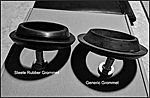
No matter where the owner decides to mount the switch on his car, it is imperative that the routing of the positive cable is done in a responsible safe manner. Rubber protected Adel clamps on the frame, grommets that go through frame rails or sheet metal, if not grommets then pieces of 5/8ths heater hose going through metal passageways, etc. Connections must be secure, and the two posts where the cables attach on the switch free from any grounding source around them. With the new coverings of the heavier battery cables, if the cable is securely fastened in its travels from the battery, to the switch, to the solenoid or starter, problems will be avoided.

Recently, on Saturday, June 18th, several of my club members and I participated in the Second Annual Horsepower Car Show at the Emerald Downs horse racing facility in Auburn, Washington. It was raining when we arrived, and rained all day. The four of us parked together, several parking slots away from the feature car that was on the dash placque for this event. It was a customized 1938 Ford pickup that had a tilt bed instead of the pickup box that was on it from the factory. The bed was raised up to its maximum height, looking much like a dump truck would. It was painted several colors of lilac, purple and blue. It had ghost flames to enhance the front end. The door handles had been shaved, with remote openers under the bottom of the cab. The battery was located in the very rear of the frame on the passenger side. Being it was a GM 350 V-8 installation, it made sense to run the Positive cable up the frame rail to the disconnect switch, which was on the floor under the passenger seat, then to the starter lug. The gas tank was a custom stainless steel unit. It was shaped like a box, with welded seams and corners. The vent on the top was less than an inch high. The gauge sending unit was also on the top. It was sealed with some kind of mastic or urethane sealer, and sat towards the front edge of the tank. About a half hour after we arrived on site, we happened to look over at his truck, and blue smoke was pouring out from under it. While we didn't see flames, it was definitely on fire. It was like the gas from the very full tank was either seeping out of weld holes, coming out of the vent, or some other source, and sheeting down the sides of the tank. The source of the ignition was caused by the positive battery cable passing by it on its way to the disconnect switch. Well, my friends and I all carry at least, three pound fire extinguishers, and we drenched the fire with them. That seemed to quell the fire to some extent, but it started up again. The owner wasn't nearby at the onset, but after ten minutes or so, he showed up, and immediately went to turn off his battery disconnect switch. He had trouble getting the passenger door open, but did eventually. But shutting the switch off did nothing to stop the fire, because the power was still traveling up the cable because of the rear mounted battery. My friend who was parked the closest to him, suggested he disconnect the battery, so the guy asked for a half inch wrench. There might be a half inch nut on a truck or other bigger vehicle, but the standard for automobiles is 7/16ths inch. So my friend lent him a 7/16th wrench, and he promptly disconnected the battery cable from the battery. The fire stopped immediately.

On further inspection of the battery cable, we found that whoever had installed it, whether it was the owner or someone else, had used a rubber encased fabric cable. It was only secured in three or four spots to the bottom of the frame rail by 1/8th in wire ties. Near the area where it passed by the tank it wasn't secured, and constant bouncing and movement had caused it to chafe through the covering so that bare copper was showing in several places. First, he was lucky that it didn't short out his electrical system when he was driving along, but secondly he was lucky that it didn't burn the truck up, explode, and cause damage to other vehicles or participants that were parked near him! He took the car home on a commercial flat bed towing vehicle.

Normally, it is best to try to run the ground cable of the battery to a bolt as close to the starter as possible. It that isn't a possibility, then when grounding the cable to the frame, all of the other grounding straps or cable should be equivalent in size to the battery grounding cable. In other words, if your battery cables are #3 or #4, the cable from the frame to the body, frame to the engine, and engine to the body should all be the same size. This equalizes the system and eliminates the resistance that is caused by using smaller wire or small flat ground straps.

Our Washington Safety team has found that there is another issue regarding the attaching of the positive lead from the battery to the starter, or from the solenoid to the starter. When attaching this cable to the starter, first secure the nut securing the lug to the starter. THEN, using a tappet wrench ( a tappet wrench was used on the Chevrolet sixes and other engines that had adjustable tappets. It is a thin wrench that is equivalent to the size of the nut that holds the post secure) hold the nut while you add the battery cable, the lock washer, and the top nut. Too often, whoever is doing this installation doesn't hold that inner nut when tightening the outer nut and they break loose the lug or post inside the starter itself. This causes a heck of a lot of resistance and results in hard starting, fluctuating headlights, and other electrically related problems. You can verify this by reaching down and grabbing the battery cable where it attaches to the starter. If it is secured properly, it won't move. But if it moves easily or freely, then you will experience these problems. If the manifolds are hot, use an oven glove, such as the one your wife uses for hot pans in the kitchen and you won't burn the back of your hand or wrist!

___________________________________________________________________

Back to the list of stories.

___________________________________________________________________

Gary (finally) gets a good vibration

Gary Rushers Plymouth runs so smooth, he feels like he has a new car. As we all know Gary has been fighting a vibration problem in his 1930U Coupe for a long time.

He replaced both the front and rear motor mounts with little effect on the vibrations.

After being told that ignition and timing were the problem, he had the valves timed and the distributor rebuilt.

The vibration did not stop and the car acted as if it might be starving for fuel, so he took the carburetor apart and found that the float was improperly set. Fixing it didn’t help.

While looking at the fuel issue he went whole hog, removing, cleaning and sealing the gas tank. A fuel pump rebuild went awry when the company that rebuilt it broke the upper housing, so Gary had got parts from Doug Crawford at Elderly Auto, and rebuilt it himself. It made no difference.

Recently, Pat Brost and Bob Westphal suggested that he should check the ignition again. Maybe one of the springs on the centrifugal advance was bad, or maybe one of the lobes on the distributor shaft was worn.

Bingo! The distributor shaft had a lot of play, allowing the shaft to swing as it rotated, making for very irregular firing. It was a surprise, because the distributor was allegedly rebuilt with new bushings only two years before (by the same company that broke the fuel pump).

Proper repair of the distributor has solved the problem. Gary got new bushings from Doug Crawford at Elderly Auto. Don Ryan made up a nice push shaft and installed the new bushing for Gary. Gary installed the distributor and timed the engine.

A test drive of the car found no engine vibrations and zero lurching. The car runs out nice and smoothly, up to 50 MPH, which was Gary’s limit although he swears the car still had more to give.

It doesn’t drive exactly like a new car, but Gary is happy with the change, and he’s grateful to Pat, Bob and Don for their help and advice.

___________________________________________________________________

Back to the list of stories.

___________________________________________________________________